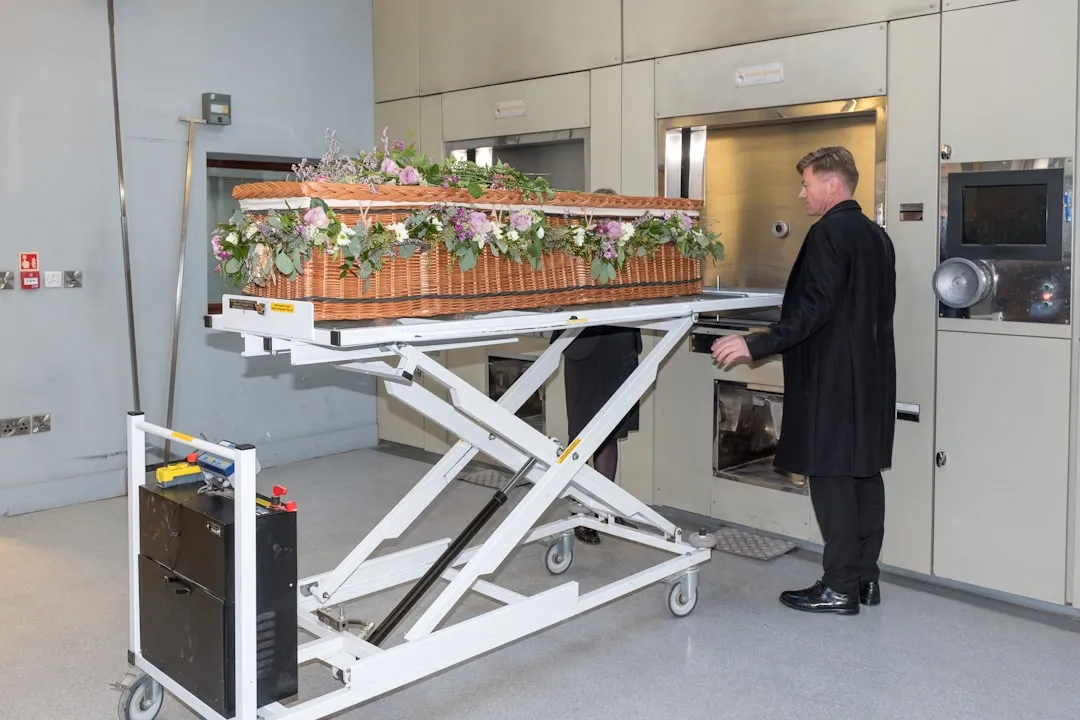
Every outsourced cremation is a check you’re writing to someone else’s bottom line. At 63% cremation rate nationally — and climbing past 80% in states like Washington, Oregon, and Nevada — that check gets bigger every year. If you’ve just acquired a funeral home or you’re deep in due diligence on one, this is the capital allocation question that will define your margins for the next decade.
The retort (the furnace unit itself) isn’t cheap. A full crematory buildout runs $200K–$700K depending on your market, your volume, and how much facility work you need. But the math isn’t complicated. It’s a volume game with a clear break-even point, and once you cross it, every additional cremation drops almost straight to your bottom line.
This guide walks you through the full decision: costs, volume thresholds, permitting timelines, operational realities, and a five-part framework for whether building makes sense for your specific acquisition.
The Economics Forcing the Question
The cremation rate in the United States hit 63.1% in 2025, up from 57.5% just five years earlier. The Cremation Association of North America (CANA) projects it will reach 80% nationally by 2040. In the Pacific Northwest and parts of New England, you’re already there.
This isn’t a trend. It’s a structural shift in how Americans handle disposition, and it rewrites the revenue math for every funeral home in the country. For a deeper look at how cremation rate trends reshape acquisition economics, start there.
What outsourcing actually costs you:
- Typical outsourced cremation fee: $150–$350 per case
- Average funeral home markup to families: $350–$800 for “cremation services”
- Your margin on each outsourced cremation: thin, and getting thinner as third-party providers raise rates
- Your margin on each in-house cremation: substantially higher, with the equipment cost already sunk
Run the simple math on a mid-volume home. Say you’re handling 200 cremation cases per year — modest for a home doing 300+ total calls. At $250 average outsourcing cost, that’s $50,000 per year leaving your business. Over a five-year hold period, that’s $250,000 in margin you could have captured.
Now look at it from the margin side. Funeral homes with captive crematories — meaning they own and operate the retort on-site or nearby — consistently report net margins in the 20–30% range. Homes outsourcing cremation typically land between 8–20%. The gap is almost entirely attributable to cremation economics.
The competitive pressure is real, too. If your closest competitor owns a crematory and you don’t, they can price cremation packages more aggressively while maintaining healthier margins. In a market where price-sensitive families are shopping cremation providers online, that’s a meaningful disadvantage.
And here’s the kicker for buyers specifically: if you’re evaluating an acquisition and the seller has been outsourcing cremation for years, that’s actually an opportunity. The current owner’s margins are depressed, which may lower the purchase price. Post-acquisition, adding a crematory is one of the highest-ROI capital improvements available to you.
What a Crematory Actually Costs
Let’s kill the ambiguity. Here’s what you’re actually looking at in capital outlay, broken into the four major cost buckets.
Equipment: $100K–$500K
The retort is the centerpiece. Pricing depends on:
- Single-chamber human cremation retort: $100K–$200K for a standard unit
- High-efficiency retort with secondary chamber: $175K–$300K — better emissions performance, faster cycle times
- Multi-retort installation (2–3 units): $300K–$500K — needed at 500+ cremations/year or if you plan to take third-party volume
- Cremation processor (pulverizer): $5K–$15K — processes cremated remains into the fine powder families receive
- Cooling and handling equipment: $3K–$8K
Major manufacturers include B&L Cremation Systems, Matthews Environmental Solutions, and US Cremation Equipment. Each has different price points, efficiency ratings, and emissions profiles. Get quotes from at least three.
Key spec to watch: cycle time. A standard retort handles one cremation in 2–3 hours. High-efficiency models can run 90-minute cycles. That difference matters enormously at scale — it’s the difference between 4 and 6 cremations per day on a single unit.
Facility: $50K–$200K
You need a building or an addition to house the equipment. Requirements include:
- Reinforced concrete pad for the retort (these units weigh 10,000–20,000 lbs)
- Adequate ceiling height — 12 feet minimum, 14–16 preferred
- Ventilation and stack installation — the flue/chimney system
- Receiving and holding area — refrigerated storage for cases awaiting cremation
- Viewing room (optional but increasingly expected) — for witnessed cremations
- ADA-compliant access if families will enter the space
If your existing funeral home has unused outbuilding space or a large garage structure, conversion costs land on the lower end. A ground-up addition on your existing property pushes toward $150K–$200K. A separate off-site crematory building can exceed that, but gives you more flexibility on zoning.
Permitting and Environmental: $15K–$50K+ in Direct Costs
This is where surprises live. Budget for:
- Environmental impact assessment: $5K–$15K
- Air quality permit application fees: $2K–$10K (varies wildly by state)
- Legal and consulting fees: $5K–$20K if you face opposition or complex zoning
- Emissions testing and monitoring equipment: $3K–$8K
- Ongoing compliance costs: $2K–$5K/year
The dollar cost isn’t the real issue. The timeline is. More on that below.
Total Project Cost and Financing
Realistic all-in ranges:
| Scenario | Equipment | Facility | Permitting | Total |
|---|---|---|---|---|
| Single retort, existing space | $150K | $50K | $20K | $220K |
| Single retort, new addition | $175K | $150K | $30K | $355K |
| Dual retort, new building | $350K | $200K | $50K | $600K |
Financing options worth exploring:
- Equipment financing through the manufacturer: Many retort manufacturers offer 48–60 month financing, sometimes through partners like FT Partner Pay. Rates are competitive because the equipment serves as collateral.
- SBA 7(a) or 504 loans: If you used SBA financing for the acquisition itself, you may be able to fold crematory construction into a 504 loan for the real estate/equipment component. The 504 program is specifically designed for major fixed-asset purchases.
- Traditional equipment loans: Banks familiar with the death care industry (and there are lenders who specialize) will underwrite crematory projects at 5–7 year terms.
- Cash from operations: If your acquisition is already cash-flowing well and you have 12–18 months of post-acquisition operating history, self-funding avoids debt service entirely.
One financing mistake to avoid: don’t raid your operating reserves to fund the buildout. Crematory construction always takes longer and costs more than the initial quote. Keep a 15–20% contingency buffer. For more on how crematory investment changes your financial model and KPIs, see our financial modeling guide.
The Volume Threshold: When the Numbers Work
This is the section that actually answers the question. Everything else is context. Here’s the math.
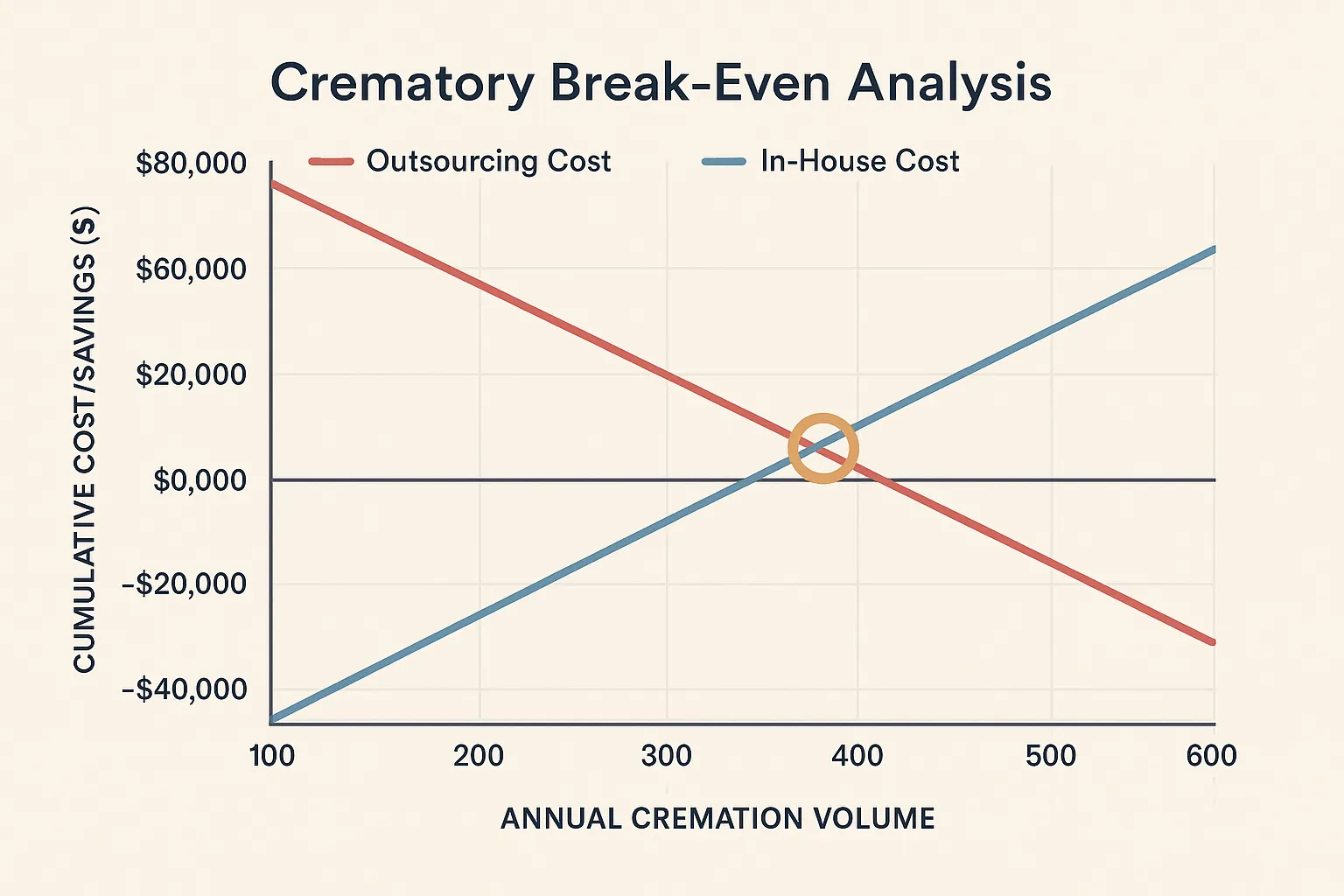
The Break-Even Calculation
The break-even point for a crematory depends on three variables:
- Your total capital investment (let’s use $300K as a middle scenario)
- Your per-cremation outsourcing cost (let’s use $250)
- Your per-cremation operating cost when doing it in-house (typically $50–$80 including gas, electricity, labor allocation, and consumables)
Net savings per cremation brought in-house: $250 − $65 (midpoint operating cost) = $185
Annual break-even volume: $300,000 ÷ 5-year payback target = $60,000/year in savings needed
$60,000 ÷ $185 per cremation = 325 cremations/year to hit a 5-year payback
Want a 3-year payback? You need about 540 cremations per year from your own volume alone.
The Real-World Threshold
Most industry consultants and operators put the practical threshold at 200–250 cremations per year as the minimum where owning a retort starts to make financial sense. Below that, the numbers work but barely — your payback period stretches to 7–10 years, maintenance costs eat into thin margins, and the operational complexity isn’t justified.
Here’s the volume framework:
- Under 150 cremations/year: Keep outsourcing. The math doesn’t work unless you have a clear path to volume growth within 2–3 years.
- 150–250 cremations/year: Borderline. Only pursue if you can capture third-party volume (see below) or if your market’s cremation rate is rapidly climbing.
- 250–400 cremations/year: Strong case to build. Payback period lands in the 3–5 year sweet spot.
- 400+ cremations/year: You’re leaving significant money on the table every month you don’t own a retort.
The Third-Party Revenue Multiplier
Here’s where the economics get genuinely compelling. Once you own a crematory, you don’t just serve your own families. You become a cremation provider for other funeral homes in your area that also outsource.
This is common and accepted in the industry. Many funeral homes — especially smaller operators doing under 100 cremations per year — will never justify their own retort. They need a local provider. If you build, you become that provider.
What third-party cremation looks like:
- You charge other funeral homes $200–$300 per cremation (the same rate they were paying their previous provider)
- Your marginal cost per additional cremation is $50–$80
- Every third-party cremation is essentially $120–$250 in nearly pure margin
- A busy crematory serving 3–5 other funeral homes can add 100–300 additional cremations per year
This third-party revenue can cut your payback period in half. It also creates a competitive moat — those funeral homes become dependent on your crematory, which makes your business more valuable and harder to compete against.
One caution: don’t build your financial model assuming third-party volume. Model it on your own cases first. Third-party revenue is upside, not the base case.
Payback Period Summary
| Your Annual Volume | Third-Party Volume | Total | Est. Payback ($300K investment) |
|---|---|---|---|
| 200 | 0 | 200 | 8+ years |
| 200 | 100 | 300 | 5.4 years |
| 300 | 0 | 300 | 5.4 years |
| 300 | 150 | 450 | 3.6 years |
| 400 | 100 | 500 | 3.2 years |
| 400 | 200 | 600 | 2.7 years |
Permitting and Environmental Compliance: The Real Timeline
If there’s one section of this guide to take seriously, it’s this one. Permitting is the longest lead-time item in a crematory project, and it’s the one most likely to derail your timeline or kill the project entirely. For broader context on environmental and OSHA compliance in funeral home acquisitions, read our dedicated compliance guide.
Air Quality Permits
Every state requires an air quality permit for crematory operations. The retort’s emissions — primarily particulate matter, mercury (from dental amalgam), and other trace pollutants — are regulated under the Clean Air Act and various state-level statutes.
What you need to know:
- New Source Review (NSR) or equivalent state process is typically required before construction
- Emissions standards vary significantly by state. California, Colorado, and several Northeast states have stricter limits than the federal baseline
- Modern retorts with secondary combustion chambers meet most state standards out of the box — but you still need the permit
- Application-to-approval timeline: 3–12 months depending on the state and whether your application triggers additional review
Start this process before you finalize equipment selection. Some states’ emissions limits will dictate which retort models you can install.
Zoning
Zoning is where projects die. A crematory is an industrial use in most zoning codes, even if it’s attached to a funeral home that’s permitted as a commercial or institutional use.
Common zoning scenarios:
- Your funeral home is in a commercially zoned area: You’ll likely need a special use permit or conditional use permit (CUP) for the crematory. This means a public hearing.
- Your funeral home is in a residentially zoned area (older homes grandfathered in): Adding a crematory may be extremely difficult or impossible without a variance.
- You’re building off-site in an industrial zone: Easiest path, but you lose the convenience of on-site operation.
The public hearing is where NIMBY opposition shows up. Neighbors concerned about smoke, odor, emissions, property values, and “the principle of the thing” will attend. Be prepared with:
- Emissions data from your equipment manufacturer showing modern retorts produce virtually no visible smoke or odor
- Traffic impact analysis (minimal — you’re adding a few vehicle trips per day)
- Economic benefit data (jobs, tax revenue)
- Letters of support from community members and local business owners
- A professional, respectful presentation — this is not the time to be dismissive of concerns
Some operators hire a land use attorney specifically for the CUP process. At $5K–$15K in legal fees, it’s worth it if your project depends on the outcome.
EPA and OSHA Requirements
EPA compliance:
- Retorts must meet 40 CFR Part 60 standards (if applicable in your state)
- Mercury emissions are an increasing area of regulatory focus
- Recordkeeping requirements for cremation logs, emissions testing, and maintenance
OSHA requirements:
- Heat stress protocols for operators
- Personal protective equipment (PPE) standards
- Lockout/tagout procedures for maintenance
- Handling protocols for remains with pacemakers (lithium batteries can explode in a retort — this is a real and serious safety concern)
The Timeline You Should Actually Plan For
Forget the optimistic estimates from equipment sales reps. Here’s a realistic crematory project timeline:
- Months 1–2: Feasibility study, site assessment, equipment evaluation
- Months 2–4: Zoning research, pre-application meetings with planning department
- Months 4–8: Air quality permit application, zoning/CUP application filed
- Months 6–12: Public hearings, permit review, possible appeals
- Months 10–14: Construction/installation (assuming permits approved)
- Months 14–16: Equipment commissioning, testing, staff training
- Month 16–18: Operational launch
Total: 12–18 months from decision to first cremation. Plan accordingly. If you’re acquiring a funeral home and want a crematory operational within your first two years of ownership, start the permitting process within 60 days of closing.
Operations: Running a Crematory Day to Day
Owning the retort is an investment decision. Operating it is an operational commitment. Here’s what daily life looks like once the crematory is running.
Staffing
A crematory doesn’t require a large team, but it requires a dedicated one.
- One trained operator can handle 3–4 cremations per day on a single retort with modern automation
- For a single-retort operation doing 250–400 cremations/year, one full-time operator plus a trained backup (often a funeral director who cross-trains) is sufficient
- For multi-retort operations above 500/year, you’ll want two full-time operators plus backup coverage
- Operator compensation: $40K–$60K in most markets, higher in metro areas and states with certification requirements
Many smaller operators staff the crematory with existing funeral home employees who take on dual roles. This works at lower volumes but creates burnout risk and scheduling conflicts above 300 cases per year.
Training and Certification
CANA (Cremation Association of North America) certification is the industry standard. It’s not legally required in every state, but it should be your baseline.
Training components:
- Manufacturer training: Every retort manufacturer provides initial operator training with equipment purchase — typically 2–3 days on-site. Take this seriously. It covers startup, shutdown, temperature management, and troubleshooting.
- CANA Cremation Operator Certification: A comprehensive program covering the cremation process, legal requirements, identification procedures, and safety. Available online and in-person.
- State-specific requirements: Some states mandate specific crematory operator licenses. Check your state’s funeral regulatory board before hiring.
- Continuing education: Plan for annual refresher training and manufacturer updates, especially when emissions regulations change.
Maintenance
Retorts are industrial furnaces. They require consistent, scheduled maintenance to operate safely and efficiently.
Routine maintenance ($5K–$15K annually):
- Daily ash removal and chamber cleaning
- Weekly inspection of refractory lining (the heat-resistant interior)
- Monthly burner system checks and calibration
- Quarterly emissions system inspection
- Annual comprehensive service by manufacturer technician
Major maintenance:
- Refractory relining: Every 5–7 years depending on volume, $20K–$40K per retort. This is the big-ticket maintenance item. The refractory lining degrades with each cremation cycle. At high volumes (500+/year), you may need relining every 4–5 years.
- Burner replacement: Every 8–10 years, $5K–$15K
- Control system upgrades: As technology evolves, $3K–$10K
Build maintenance costs into your financial model from day one. A common mistake is modeling only the capital cost and operating costs while ignoring the maintenance reserve. Budget $10K–$15K per year per retort as a maintenance and replacement reserve.
Technology and Monitoring
Modern crematories bear little resemblance to their predecessors. Today’s systems include:
- Automated temperature control: Maintains optimal cremation temperature (1,400–1,800°F) without constant operator attention
- Remote monitoring: Cloud-connected systems that alert operators to temperature anomalies, mechanical issues, or cycle completion via smartphone
- Emissions monitoring: Real-time particulate and opacity monitoring to maintain compliance
- Scheduling software: Manages cremation scheduling, tracks chain of custody, and generates compliance documentation
- AI-assisted combustion optimization: Newer systems use machine learning to optimize fuel consumption and cycle times based on case characteristics
These technologies reduce labor requirements and improve consistency, but they add $10K–$30K to your equipment cost. For operations above 300 cremations per year, the labor savings alone justify the investment.
Chain of Custody and Identification
This is non-negotiable. A chain-of-custody failure — cremating the wrong person or returning incorrect remains to a family — is a catastrophic event for your business, legally and reputationally.
Minimum protocols:
- Unique identification tag (metal or ceramic, survives cremation) assigned at time of receipt and remaining with the deceased through the entire process
- Two-person verification before each cremation — confirming identity matches paperwork
- Digital tracking system logging every handoff, from receipt to return of cremated remains
- Secure holding area with limited, logged access
- Single-cremation policy — one person in the retort at a time, no exceptions, ever
- Post-cremation processing protocol — ensuring all remains are recovered and the chamber is cleared before the next case
Document everything. Your state likely has specific chain-of-custody regulations, and your insurance carrier will have requirements as well.
The Decision Framework: Should You Build or Keep Outsourcing?
Here’s the framework distilled into five tests. Be honest with each one.
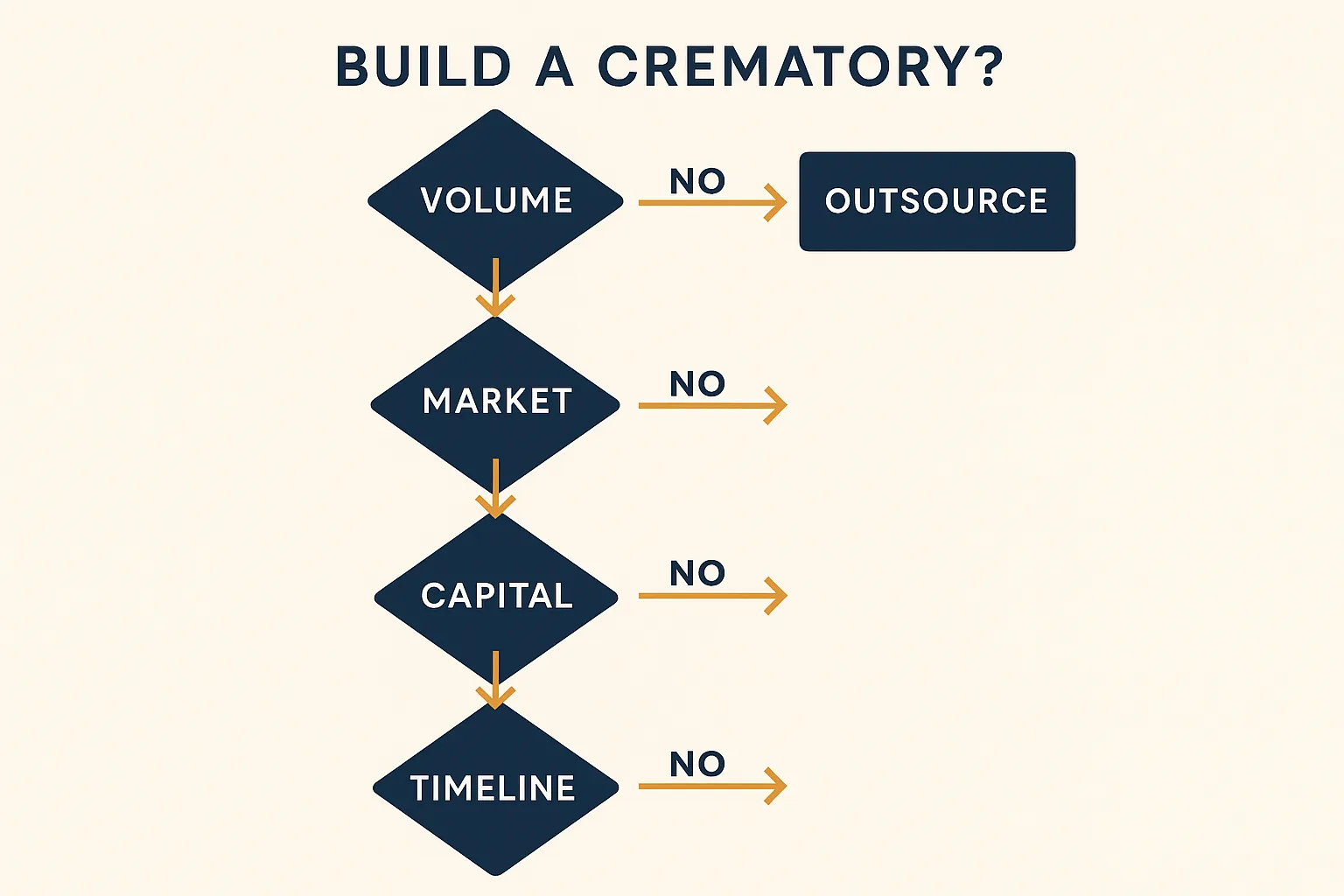
Test 1: Volume
Question: Will you perform 200+ cremations per year within 24 months of the crematory opening?
Count your current cremation cases. Add realistic third-party volume from funeral homes within a 30-mile radius that currently outsource. If you can’t get to 200 with a straight face, the answer is not yet.
Pass/fail threshold: 200+ projected annual cremations = pass.
Test 2: Market
Question: Is your market’s cremation rate above 50%, and is it still climbing?
Check your state and county cremation data through CANA or your state funeral directors association. If you’re in a market where cremation is already dominant and growing, the volume will come to you. If you’re in a market where burial still dominates (parts of the rural South, for instance), the timeline is longer.
Also assess competition. If another local operator already has a crematory with excess capacity, they’ll fight to keep third-party volume. Your margin for capturing additional cases shrinks.
Pass/fail threshold: Market cremation rate above 50% with no dominant local crematory competitor = pass.
Test 3: Capital
Question: Can you fund the project without jeopardizing your operating reserves or overleveraging the business?
A $300K–$500K capital project on top of acquisition debt requires careful financial planning. Run the numbers with your accountant. Make sure you can service the additional debt (or deploy the cash) while maintaining 6+ months of operating reserves.
Pass/fail threshold: Fundable within a healthy capital structure = pass.
Test 4: Regulatory
Question: Is permitting achievable in your jurisdiction within 12 months?
Do the homework before committing capital. Meet with your local planning department. Talk to the state environmental agency. If your zoning is wrong, your neighbors are organized, or your state’s permitting backlog is 18+ months, you need to know before you spend money.
Pass/fail threshold: Realistic path to permits within 12 months = pass.
Test 5: Timeline
Question: Does a 12–18 month buildout fit your business plan?
If you need margin improvement immediately, a crematory isn’t the answer — it’s a medium-term investment. If you’re planning a 3–5 year hold (or longer), the payback math works well. If you’re planning to flip the business in 18 months, the crematory may not be operational before you sell (though it could increase your exit multiple).
Pass/fail threshold: Business plan supports 18-month capital project = pass.
Scoring
- Pass all five: Build. Start permitting this month.
- Pass four, fail one: Probably build, but address the failing test first. If it’s regulatory, engage a land use attorney. If it’s volume, work on growing cases before committing capital.
- Pass three or fewer: Outsource for now. Revisit in 2–3 years. Market conditions change, volume grows, regulatory environments shift. The opportunity doesn’t disappear — it just isn’t ripe yet.
The Bottom Line
Owning a crematory is one of the most impactful capital investments a funeral home buyer can make. At sufficient volume, it transforms your margin structure, creates a competitive moat, generates third-party revenue, and increases your business’s enterprise value.
But it’s not a universal yes. It’s a volume-dependent, market-specific, capital-intensive decision that requires honest analysis and patience through a long permitting process.
Do the math on your specific situation. Use real numbers, not hopes. If the five tests come back positive, move fast on permitting — it’s your longest lead-time item and every month of delay is another month of outsourcing costs you didn’t need to pay.
If the tests say wait, then wait. There’s no shame in outsourcing while your volume grows. The retort will still be there when your numbers are ready for it.
Frequently Asked Questions
How many cremations per year do I need to justify building a crematory?
The practical minimum is 200–250 cremations per year from your own volume. Below that threshold, outsourcing remains more cost-effective. Third-party cremation revenue from other funeral homes can lower this threshold, but don’t build your base financial model around volume you haven’t secured yet.
How long does it take to build a crematory from start to finish?
Plan for 12–18 months from initial decision to first cremation. Permitting — particularly air quality and zoning approvals — is the longest lead-time item, often taking 6–12 months on its own. Construction and equipment installation typically take 4–6 months once permits are in hand.
Can I add a crematory to my existing funeral home property?
Often yes, but it depends on your zoning classification, available space, and local regulations. Many funeral homes add crematories as building additions or in separate structures on the same parcel. You’ll likely need a conditional use permit, which involves a public hearing process.
What does a crematory retort cost?
A single human cremation retort ranges from $100K–$300K depending on capacity, efficiency rating, and emissions control features. Total project costs including facility, installation, and permitting typically run $200K–$700K.
How many staff do I need to run a crematory?
A single-retort operation handling 250–400 cremations per year needs one full-time operator plus a trained backup. Modern automated systems allow one operator to manage 3–4 cremations per day. Multi-retort operations above 500 annual cremations warrant two full-time operators.
This guide is part of the Funeral Home Buyer resource library — acquisition intelligence for serious buyers, from due diligence through operations.
Funeral Home Buyer provides educational content for professionals evaluating business acquisitions in the funeral services industry. This article is not legal, financial, or investment advice. Consult qualified professionals before making acquisition decisions.